

Sci-Fi Reviewed: Wool
This ain't your grandmother's dystopia

Judging for the Writers of the Future contest is done anonymously. That means contest judges don’t know the authors of stories they’re judging. And that writers don’t know the names of the judges reading their work.
Thus, while reading Wool by Hugh Howey, I had no idea that Mr. Howey had already read some of my work.
My desire to read his work arose from recent craft research into dystopian and BDO novels, and reading his story was particularly valuable as most such novels are…well, old. Ringworld, Larry Niven’s gold-standard BDO story, was published in 1970 and reads like it. Howey’s Wool, on the other hand, reads like nothing else.
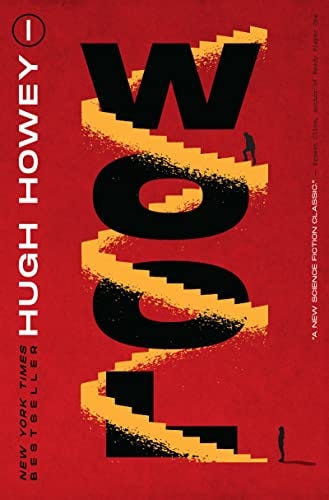
Hugh Howey judged one of my stories. It’s only fair that I return the favor. So in this month’s “Sci-Fi Reviewed”, let’s take a look at the first novel of the Silo series, Wool. What makes it work, what kept me reading, and why it’s no surprise to me that Hugh Howey did what few authors have, and found the “back door” of the modern publishing industry.
The Plot
Wool begins with perhaps the best opening line of any novel I’ve ever read:
“The children were playing while Holston climbed to his death…”
For the record, kids, that is how you start a story. I was instantly intrigued, and sure enough, I soon realized I was reading a story where the main POV character died in the opening pages. To say the least, in literature that is a risk. But Howey pulled it off.
From the get-go, the first part of the book feels like a sort of relay race: the first two POV characters die, each passing the story’s mic to the next, compounding the mystery for the next character to solve (it’s worth noting that Howey originally wrote the first part of this novel as a series of short stories; it shows, but in a good way). Through it all, the reader is organically introduced to the characters’ world: the Silo, where a tiny kernel of humanity survives within a sealed habitat, buried beneath the surface of a ruined Earth.
All of this leads inexorably to the introduction of Juliette Nichols: a mechanic living in the bowels of the Silo, who was mysteriously suggested as the new sheriff by the previous one: the ill-fated Holston. As the conspiracy growing within the silo generates more bodies, Juliette races to solve the previous mayor’s murder until the conspiracy wraps her up, as well. No sooner does she realize that the head of the Silo’s IT department, Bernard, is responsible for an outrageous cover-up than she faces the ultimate punishment of their laws: banishment to the surface.
At that point, the story diverges into true multi-POV, dividing the plot between Juliette (who becomes the only person in the Silo’s recorded history to survive on the surface), Lukas (the IT worker shadowing Bernard, who’d fallen in love with Juliette), and Juliette’s friends in mechanical, who use her banishment under false pretenses as a rallying cry to stage an uprising.
My Take
When the stories comprising Wool were first collected and released as a novel, post-apocalyptic dystopia was all the rage in science fiction. But until the past few months, I hadn’t read Wool, for one big reason: I do not like post-apocalyptic dystopia. But a lot has changed over the past year (among other things, I began writing dystopia). And I’m glad I finally got around to reading this story, because I thoroughly enjoyed it.
There are elements of it that felt very conventional to me (unpleasantly so, at times). It hits all the notes of post-apocalyptic sci-fi, obviously: a ruined Earth, humanity desperately struggling to survive, a nebulous concept of how things got so bad, conspiracy, tyrannical leaders and resistance. The prose, too, feels very conventional, to the point where the structures of sentences are easy to predict.
But where it truly shines is in its structure. Howey has an incredible knack for something even some of the best novelists struggle with: knowing where to focus the lens of the story at every single moment. The early chapters, where one POV character after another dies under tragic and mysterious circumstances, doesn’t grind the story to a halt; rather, it propels it forward. When the story first diverges, the reader sees Juliette’s inexplicable survival on the surface first through the eyes of those remaining in the Silo; only several chapters in does Howey show what actually happened through Juliette’s eyes.
And from there he does what every multi-POV writer should do: he keeps a POV character in each spot where the action is happening; a representative, if you will. It helps to build intrigue without leaving the reader scratching their head. I don’t know that I’ve ever read a story that was so perfectly laid-out and planned. The fact that it started as a series of short fiction pieces only makes it that much more impressive.
So yes, Mr. Howey, if you’re reading this, I’m glad you enjoyed my story.
I thoroughly enjoyed yours, too. - MK